AquaSky unit completion
After a longer break, I’m bringing new updates about the AquaSky unit. At the end of September, I completed its software version 1.0.0. It was a long and demanding process that required a lot of time, effort, and new equipment — all within a workspace measuring only 3.6 × 1.3 meters.
Below is a summary of what the unit can do in its current version.
 LED Control
- Programmable control of up to 4 independent LED channels in the 12–24 V range.
- Each channel has PWM resolution better than 0.001%.
- Built‑in protection disables the output if the current of any channel exceeds 5.5 A.
- PWM values can be defined using a table with up to 100 time points with 1‑second precision.
- Each point can use either a step or fade transition.
 Auxiliary Outputs
- Programmable control of up to 2 auxiliary channels (5 V or 12–24 V) which do not require PWM.
- Time control using a time window with 1‑minute precision.
- Option to define a trigger based on LED current or power, including hysteresis.
- Total available current for auxiliary channels is 0.7 A.
- Integrated overcurrent protection that limits current when the threshold is exceeded (future versions may include extended logic).
 Communication
- Configuration and programming through the app using Bluetooth LE (min. 4.0).
- The app allows changing the device name and PIN code.
- If the PIN is forgotten, a Bluetooth settings reset can be performed using the button.
 Date and Time
- Date, time, and time zone are set from the control app.
- Automatic daylight saving time adjustment based on the selected zone.
- The time is backed up by a battery, so it is not lost during power outages.
 Additional Features
- Operating voltage 12–24 V.
- If the voltage drops below 9 V, the LED channels turn off and reactivate only after returning to a safe range.
- The same protection applies when exceeding 25 V.
- The unit automatically goes to sleep when all LED channels are at zero to reduce power consumption. It wakes up automatically just before activating the outputs.
- Firmware updates are performed through the control app — enabling feature additions and bug fixes remotely.
- The main control button has multiple functions:
- start / stop the program
- reset Bluetooth settings (hold 5–10 s)
- clear storage and settings (hold 10–15 s)
- factory reset including reverting to the factory firmware (hold 7 s after connecting power)
- The second button is used to wake the unit if it is asleep.
 Power Consumption
The following table shows the unit’s power consumption. For comparison, I also include measurements of the TC420 unit:
| Mode | Current (mA) | Power (W) | ||
|---|---|---|---|---|
| 12 V | 24 V | 12 V | 24 V | |
| AquaSky – running | 22.5 | 12.5 | 0.27 | 0.300 |
| AquaSky – sleeping | 0.25 | 0.57 | 0.003 | 0.014 |
| TC420 | 62.6 | 34.7 | 0.751 | 0.833 |
 Manufacturing
Manufacturing the unit is very time‑consuming. I don’t have a production line, so I assemble every component by hand using tweezers and a magnifier.
- Assembling the small components takes approximately 5 hours.
- This is followed by inspection and possible solder joint repairs — another 4–5 hours.
- Then I assemble the large components and connectors, build the enclosure, and perform stress tests and long‑term aquarium testing to verify time stability and set the calibration constant.
I have built two additional units that I’m considering offering for sale. The biggest cost factor is, of course, the time required for manual assembly, so without a production line I cannot compete with “Made in China” prices.
 Control App
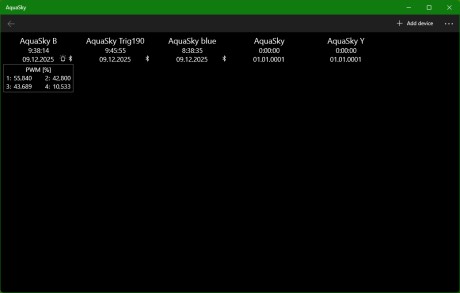
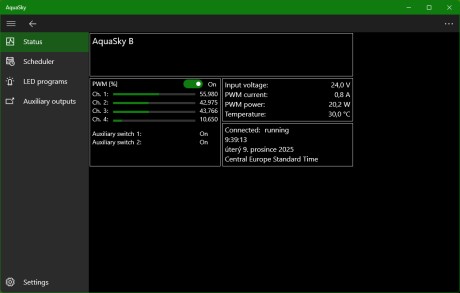
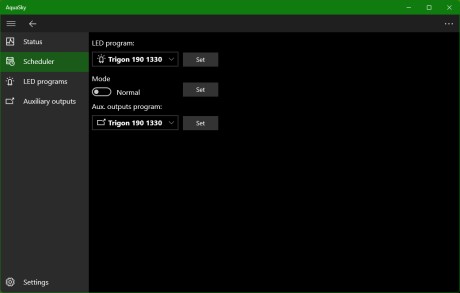
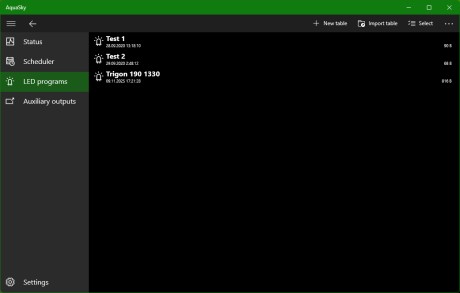
I spent the last month finalizing the control app. The UWP model is outdated today, so I had to deal with several technical challenges. Nevertheless, I managed to complete a stable version just before midnight on December 31, 2025!
I would like to publish the app in the Microsoft Store, which will require creating a developer account — likely a paid one.
Preview of picture in folder 01/2026